Custom AI solutions
AI assistants and tools designed around your business.
A custom AI solution connects a model to the information, permissions and actions your business needs. TCT designs the interface and integrations around your team, from an internal knowledge assistant to a document review tool.
Talk about your project ↗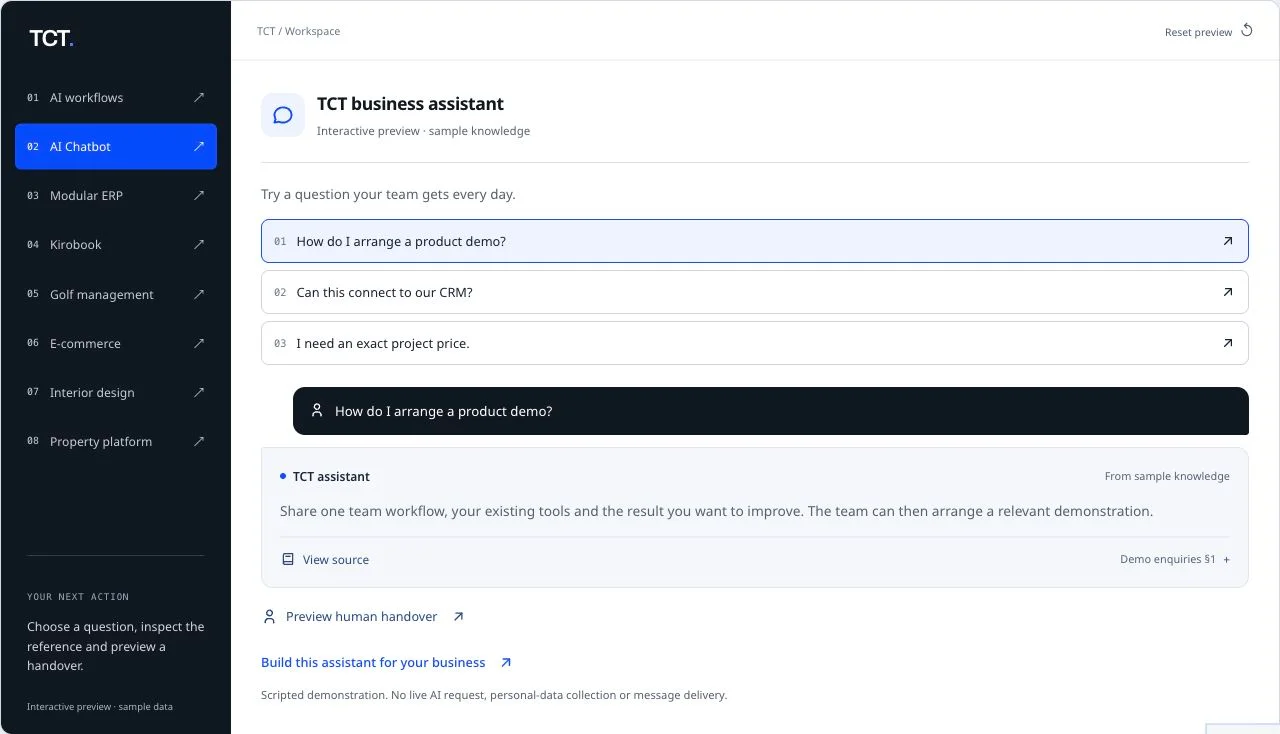
THE RIGHT FIT
Built around the work. Clear from the start.
Teams with specialised knowledge, complex documents or workflows that a ready-made chatbot cannot handle reliably. Start with a representative set of tasks and the people who will review the results.
Try a product workflow ↗How we deliver
- Define the task, approved sources, users and success criteria.
- Choose an existing model and retrieval or rules before considering model customisation.
- Build the interface, permissions, integrations and evaluation set.
- Pilot with users, review failures and agree monitoring, costs and handover.
A custom solution does not always require training a new model. Data residency, provider retention, operating costs and access controls are project decisions. TCT is based in Kuala Lumpur; Singapore projects can be scoped for remote delivery.
Your company knowledge. The right answer, with its source.
Scope an internal assistant around the information each team is allowed to use. Agree which sources are authoritative and how the assistant responds when they do not contain an answer.
Scope this workflow with us ↗Prepare
Choose approved documents, identify their owners and remove obsolete versions.
Retrieve
Find relevant passages within the signed-in user’s permitted sources.
Answer
Present a useful answer with its supporting reference, or ask for clarification.
Improve
Send unresolved questions to the owner and repeat the evaluation when knowledge changes.
What to bring to the first conversation.
- A maintained set of documents, with owners, versions and access rules.
- Representative questions, expected answers and questions that should remain unanswered.
- The intended staff interface, sign-in method and escalation owner.
What should pass before launch.
- A restricted document cannot be retrieved by an unauthorised user.
- An answer’s reference supports the actual claim, not merely a related topic.
- Missing or conflicting information produces a clarification or an escalation.
- Replacing an obsolete document changes the answer after the agreed refresh process.
Compare the scope. Then compare the quotation.
For Malaysia-based teams and remote Singapore projects, agree the workflow, system access and acceptance evidence before comparing suppliers. Use the brief to record the same requirements for every quotation.
- Project work
- Knowledge preparation, source retrieval, user permissions, interface, integrations and evaluation.
- Recurring costs
- Model usage, document storage and indexing, hosting, source updates and support.
- Evidence to request
- Use approved questions with known answers. Check source accuracy, restricted records, outdated information and unknown answers.
Try an AI workflow.
Choose a question, inspect the answer's source and follow the handover to your team.
Explore the products. Try the workflows.
Click a product in the menu, or explore the next one.
Try a question your team gets every day.
How do I arrange a product demo?
Share one team workflow, your existing tools and the result you want to improve. The team can then arrange a relevant demonstration.
View sourceDemo enquiries · KB-DEMO
Sample knowledge excerpt
Arrange a demonstration around one team workflow, existing tools and the outcome being explored.
Download the sample evaluation pack ↗
Scripted demonstration. No live AI request, personal-data collection or message delivery.
Business answers with a clear path to your team.
Configured to your process. Ask us for a demonstration of the full product.
Choose your AI starting point.
Start with one workflow, an accountable owner and a result you can test.
AI workflow automation
Connect enquiries, documents, approvals and existing tools. Use rules for fixed steps and AI for variable content.
Custom AI development
Build assistants and interfaces around specialist knowledge, access rules and the integrations your team needs.
AI chatbots
Answer from approved knowledge, qualify enquiries and hand complex requests to your team.
A Kuala Lumpur team. Two target markets.
For Malaysian projects, start with your existing systems and local team workflow. Singapore projects can be scoped for remote collaboration, with meeting cadence, data location, system access and support agreed before work starts. Our office is at Millerz Square, Kuala Lumpur.
What goes into the scope and quotation?
Define input sources, languages, permitted actions, human handover and success criteria. Separate development, integration, knowledge preparation and testing from ongoing hosting, model usage and maintenance.
Test missing information, stale answers, restricted content, duplicate requests and unavailable systems. Use evaluation records and pilot results to decide when to expand.
Discuss an AI use case ↗Good to know. Before we build.
Custom AI development or a ready-made AI tool?
Use a ready-made product when it meets your workflow and data requirements. Consider custom development when you need specific integrations, access rules, evaluation or a branded customer experience.
Can an assistant use our company documents?
Yes, approved content can support a retrieval-based assistant. Define document owners, source freshness and access rules, and test what happens when the documents do not contain an answer.
How do you price a custom AI project?
The proposal separates discovery, implementation, integrations and testing from hosting, model usage and ongoing support. Document quality, languages and required actions affect scope. Request a quotation against the same acceptance tests.
How should access and answer quality be tested?
Prepare questions with expected answers and supporting sources, including questions the documents cannot resolve. Test restricted records with different user roles, conflicting information, stale content and failed integrations. Agree who reviews failures and repeat the evaluation when sources or models change.